
Why Solar Fits Thorhild County's Farm Country
Thorhild County is a municipal district in Census Division 13 with an unusual distinction: it contains no towns and no villages at all. Seven hamlets carry the population, including Thorhild itself, the county seat, which counted 391 people in the 2021 census, plus Radway, Egremont, Opal, Newbrook, Abee, and Long Lake. The municipal district as a whole counted 3,042 residents in 2021, down from 3,254 in 2016, spread across 1,997 square kilometres. Agriculture dominates the economy. The 2021 Census of Agriculture, summarized in the county's Alberta HUB profile, puts roughly 171,000 acres under cultivation, with about 60,000 acres of canola, 36,000 of wheat, and gross farm receipts above $84 million. That mix of working farms, acreages, and commuter households is precisely the territory where solar pays, because the heavy power users are grain dryers, heated shops, well pumps, and farmyard services sitting on open, shade-free land.
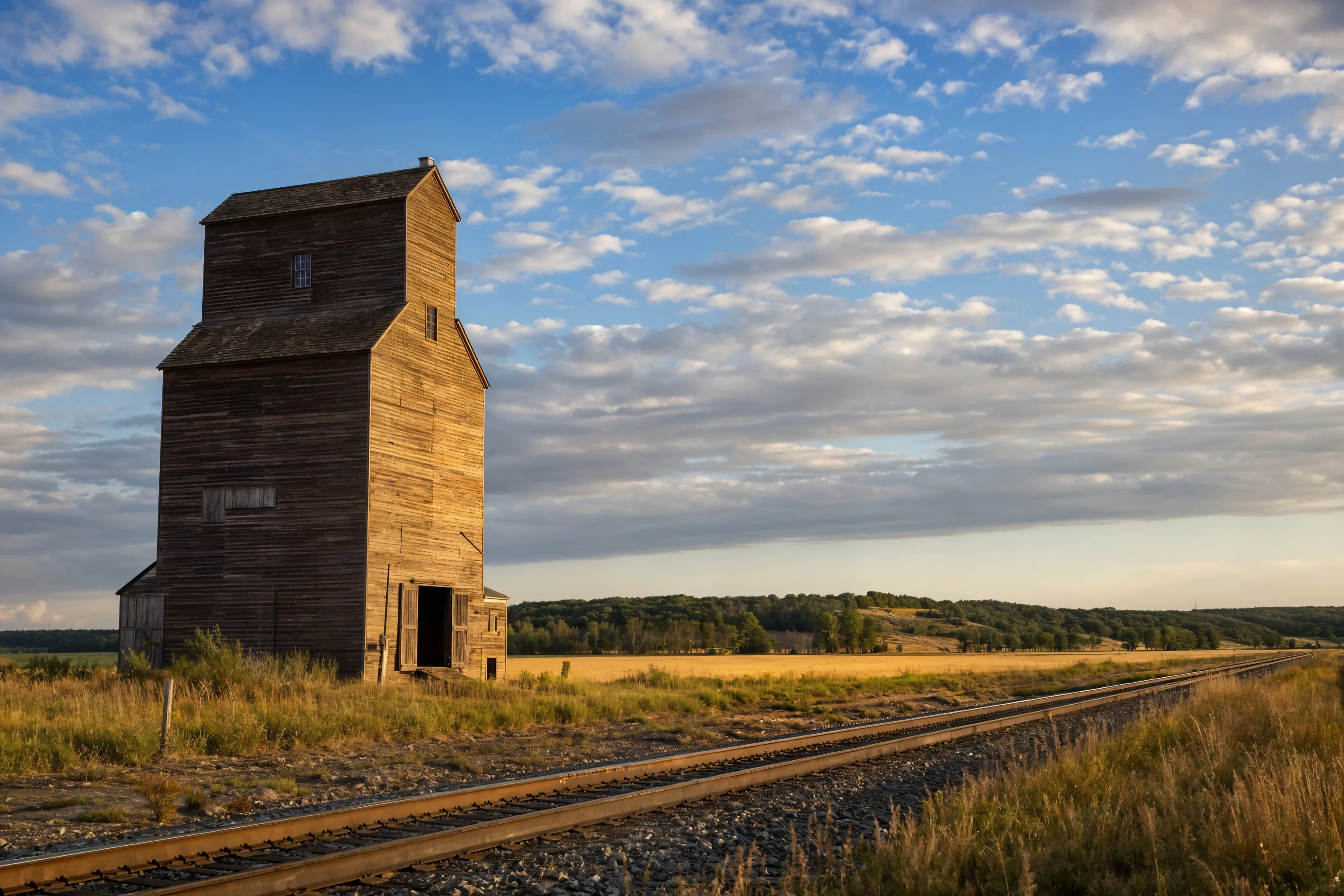
The resource is strong and well documented. Natural Resources Canada's municipal PV dataset puts a south-facing array at latitude tilt in this region at 1,169 kWh per kWp per year. Cold works in your favour here: a panel produces more per hour of sunlight at minus 20 than at plus 30, and snow slides off a tilted module within days. If you have driven Highway 28 past the last grain elevator standing in Radway, or turned north toward the campground at Long Lake Provincial Park, established in 1957 and still one of the county's busiest recreation draws, you have seen the kind of unobstructed ground that solar loves.
The financial case rests on Alberta's Micro-Generation Regulation, not on any subsidy program. Every FortisAlberta customer in the county can connect a grid-tied system, export the surplus, and take a kilowatt-hour credit that rolls forward month to month. With retail power prices where they have been, a well-sited farm or acreage array in Thorhild County typically pays for itself in roughly 9 to 15 years and keeps producing for 25 to 30. No batteries, no rate gymnastics. Payback is the number, and we show you the math before you commit to anything.
Every Thorhild County system we engineer is checked against National Building Code Appendix C climatic data. Thorhild is not a listed station, so we borrow the nearest one, Edmonton, at a 1.7 kPa ground snow load, and design racking and roof attachments above it.
What Thorhild County Properties Actually Use
System design starts with the 12-month usage graph on your FortisAlberta bill. Three property types cover most of the county:
Grain Farm with a Working Shop
A seeded quarter or half section around Egremont, Opal, or the townships south of Thorhild, running grain dryers and augers through harvest, plus a heated shop and a yard-site home. Monthly bills swing hard with the season, commonly $400 to $1,200 in fall and $150 to $350 in mid-winter, for 18,000 to 35,000 kWh a year. These are the county's best solar candidates: big annual usage, room for a 15 to 25 kW ground mount, and three-phase service on many newer yard sites.
Acreage with Shop and Well
The country-residential spreads along Highway 28 and around Radway and Newbrook: a house, a detached or in-floor-heated shop, a well pump, and sometimes a small barn. Bills typically run $250 to $500 a month year-round, for 12,000 to 18,000 kWh annually. A 10 to 14 kW array, roof or ground, offsets most of it, and summer exports bank credits against the winter heating stretch.
Hamlet Home or Long Lake Cottage
A standard residential service in Thorhild hamlet or a seasonal place near Long Lake Provincial Park, usually 7,000 to 11,000 kWh a year and bills of $130 to $280 a month depending on heating fuel and household size. A 7 to 10 kW rooftop system covers most of that usage and quietly credits the summer surplus while the place sits empty on a July weekday.
Solar Costs and Savings in Thorhild County
Installed pricing in this territory runs $2.25 to $2.85 per watt for rooftop systems and $2.50 to $3.50 per watt for ground mounts. The ground range reflects trenching, racking, and distance to the service, all of which vary quarter by quarter. Those numbers include LONGi panels, APsystems or Solis inverter hardware, racking, permits, the FortisAlberta micro-generation application, and commissioning. We quote a fixed installed price after the site assessment. We do not pitch financing products; the question here is whether the system pays for itself on your bill, and we show that math straight.
Worked examples, using the ranges honestly. Rooftop: an 8 kW system at the low end, 8,000 watts times $2.25, comes in at $18,000; a 12 kW system at the high end, 12,000 watts times $2.85, comes in at $34,200. Ground mount: a 10 kW array at $2.50 per watt is $25,000; a 20 kW array at $3.50 per watt is $70,000. Now apply the NRCan yield of 1,169 kWh per kWp, so a 10 kW array produces roughly 11,700 kWh a year. That 12 kW rooftop produces roughly 14,000 kWh a year, worth about $2,400 at a realistic all-in rate near 17 cents per kWh, which puts simple payback between 11 and 14 years depending on where the install price lands. The 20 kW ground mount produces roughly 23,400 kWh a year, about $4,000 off the bill, for a payback between 12 and 17 years on a hard site. Farms with heavier usage often beat those ranges; a small town-home system on a simple roof does a bit worse.
| Property profile | Typical system | Est. annual production | Est. annual savings | Simple payback |
|---|---|---|---|---|
| Grain farm, three-phase yard site | 18 kW ground mount | ~21,000 kWh | $3,100 to $3,900 | 12 to 17 years |
| Acreage with shop and well | 12 kW ground mount | ~14,000 kWh | $2,100 to $2,600 | 12 to 17 years |
| Hamlet home or Long Lake cottage | 8 kW rooftop | ~9,400 kWh | $1,400 to $1,800 | 11 to 14 years |
Savings assume an all-in rate near 17 cents per kWh and full use of annual production through the month-to-month credit; actual results depend on your retailer, rate plan, and consumption pattern.
FortisAlberta Interconnection in Thorhild County
Rural Thorhild County, from a farm service near Abee to the open townships along Highway 28, is wired by FortisAlberta. We verify this against the utility's own tariff: Thorhild County appears by name in FortisAlberta's AUC-approved 2026 rate schedules under Decision 30274-D01-2025, the document the utility filed effective January 1, 2026. One wrinkle: ATCO Electric's franchise-fee Rider A lists 'Thorhild & Radway', the two former villages, so a property in those hamlets may be fed by ATCO lines. We confirm the wire owner from your bill before filing, because your micro-generation application, technical review, and bi-directional meter swap all run through that company's customer generation process, whatever retailer name sits at the top of your bill.
Under the Micro-Generation Regulation, exported surplus earns a kilowatt-hour credit that rolls forward. We file the application in our Master Electrician's name, handle the safety code filing with the county or the authority having jurisdiction, and coordinate the meter swap. From submission to a swapped meter, plan on two to six weeks. Farm systems above 10 kW on a single-phase line, still common on older services in the county, can trigger a utility technical review; we check your service size at the assessment and flag that early so there are no surprises.
Working With an Airdrie Crew From the Other End of the Highway
Thorhild County sits at the far end of our service map from Airdrie, roughly 360 kilometres, about three and a half hours up the QE2 and across Highway 28 past Redwater. We take it anyway, because the properties here, grain farms and open acreages under a strong solar resource, are exactly the work we want. We batch county assessments and install days so the geography does not inflate your quote, and the first bill review happens by phone or email before anyone drives. On hardware, grid-tied installs run LONGi modules with APsystems DS3-S or DS3-L microinverters, and we spec Solis gear, the Solis 1P 7.6K for single-phase services and the S6 10kW Hybrid where a customer wants backup capability, sized to your service.
Bill review by phone or email
Send a photo or PDF of your FortisAlberta bill. We read the 12-month usage graph, check your rate class and service size, and tell you straight whether solar pencils out for your property before anyone drives north.
Batched site assessment day
We group Thorhild County assessments into regional days. We walk your rooftop or ground-mount sites, check panel condition and breaker service, measure shading, and you get a fixed installed price with a production estimate within days.
Permits and FortisAlberta filing
We file the micro-generation application with FortisAlberta and pull the electrical permit through the county or the authority having jurisdiction, depending on your address.
Install and commissioning trip
One crew installs racking, panels, inverters, and the AC disconnect, then coordinates inspection and the bi-directional meter swap. Most county systems commission within two to six weeks of the utility filing.
Thorhild County Solar Questions, Answered
See what our clients say
Real reviews from Alberta homeowners and farmers.
Get a Free Solar Assessment
We serve Thorhild County and surrounding areas. No obligation.
Also Serving Nearby Areas
Ready to Assess Your Property?
Send a recent FortisAlberta bill and we will review your consumption and give you an honest read on what solar can do for your Thorhild County property. No obligation.
Also Serving Nearby Communities