
Why Solar Fits Westlock County
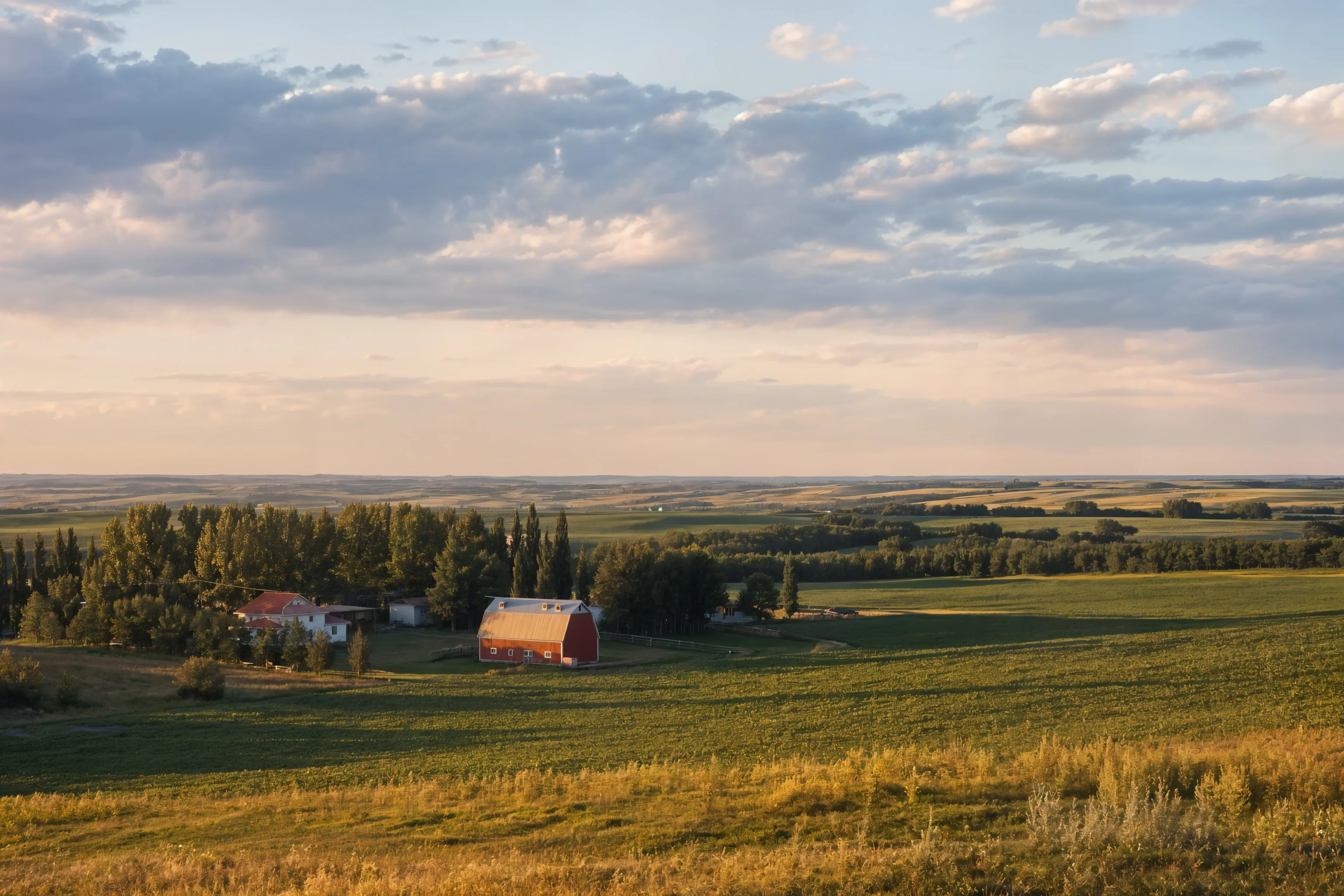
Westlock County, officially Municipal District No. 92, is farming country at a scale that is hard to appreciate until you drive it. The 2021 census counted 7,186 people spread across 3,169.66 square kilometres, a density of about 2.3 residents per square kilometre, with the Town of Westlock (4,921 people in 2021) and the Village of Clyde sitting as separate municipalities inside the county's boundaries. The 2021 Census of Agriculture counted 756 farms working roughly 660,000 acres of farmland, including about 437,500 acres of cropland and nearly 73,000 head of cattle and calves. Wheat, canola, barley, pulses, and forage dominate the cultivated acres, and the Westlock and District Agricultural Society still anchors the summer calendar with its annual fair and rodeo. That is a small population operating a very large electrical footprint, which is precisely the shape of territory where solar earns its keep.
The resource is stronger than most county residents assume. Natural Resources Canada's municipal PV dataset puts the specific yield here at 1,161 kWh per kWp per year for a south-facing array tilted at latitude, and that figure already bakes in every snowy January on record. The nearest Environment Canada station publishing bright-sunshine normals, Edmonton, logs about 2,299 hours of bright sunshine a year, and Westlock County sits in the same belt. Cold works in your favour rather than against you: a module produces more per hour of sunlight at minus 20 than it does in July heat, and snow sheds off a tilted panel within days of a storm. If you have ever stood at the Canadian Tractor Museum in Westlock, where the county held its 75th anniversary celebration, you have seen the flat, open ground that makes this corner of the aspen parkland so good for panels.
The money case rests on Alberta's Micro-Generation Regulation, not on a subsidy program that may or may not survive the next budget. Every customer here, whether your meter is fed by FortisAlberta in town or by Wild Rose REA on a rural service, can connect a grid-tied system up to 150 kW, export surplus power, and receive a kilowatt-hour credit that rolls forward month to month. With retail rates where they have been, a well-sited array in Westlock County typically pays for itself in roughly 10 to 18 years and keeps producing for 25 to 30. No batteries, no special rate class, no changes to how you live or farm.
What Westlock County Properties Actually Use
Every design we produce starts with the 12-month usage graph on your power bill, from whichever utility feeds your service. Three property types cover most of the county, and each one sizes differently.
Grain Farm with Shop and Bin Fans
A working operation along the Highway 18 corridor or north toward Dapp and Vimy, running aeration bin fans through the fall, a grain dryer at harvest, a heated shop, and a yard-site home. Monthly bills swing hard with the season: $400 to $1,200 through harvest and fan season, then $150 to $350 in a quiet February, for 18,000 to 38,000 kWh a year. These are the county's best solar candidates, with three-phase service, open ground, and a 15 to 30 kW ground mount doing the work.
Acreage with Shop and Well
The country-residential properties around Busby, Fawcett, Jarvie, and Pickardville: a house, a detached or in-floor-heated shop, a well pump, and usually a few horses or a small barn. Bills run $250 to $500 a month, fairly steady through the year, for 12,000 to 20,000 kWh annually. A 10 to 14 kW array, roof or ground, offsets most of that and banks the summer surplus as credit.
Town of Westlock Home with Electric Heat
A standard residential service in town, where baseboard or furnace-driven electric heat pushes winter bills to $250 to $450 a month and annual usage lands between 12,000 and 18,000 kWh. The town's role as the regional retail and services hub for the whole county means plenty of older housing stock with good unshaded roofs. A 9 to 14 kW rooftop system covers most of that usage and exports the long-summer-day surplus.
Solar Costs and Savings in Westlock County
Installed pricing in this territory runs $2.25 to $2.85 per watt for rooftop systems and $2.50 to $3.50 per watt for ground mounts. The ground range is wider because a farmyard array can mean a long trench back to the service, screw piles in tight soil, or a run of racking across open, windy ground. Those figures include LONGi panels, APsystems DS3 series microinverters or a Solis string inverter where the design calls for one, racking, permits, the micro-generation application with your wire owner, and commissioning. We quote a fixed installed price after the site assessment, and we do not sell financing products. The number that matters is payback.
Worked examples at both ends of the range, using the NRCan yield of 1,161 kWh per kWp. At the low end, an 8 kW rooftop on a south-facing town home runs $18,000 to $22,800 (at $2.25 to $2.85 per watt) and produces about 9,300 kWh a year, worth roughly $1,500 to $1,900 at a typical all-in rate near 17 cents, for a simple payback of 10 to 15 years. At the high end, a 16 kW ground mount on an acreage west of the town runs $40,000 to $56,000 (at $2.50 to $3.50 per watt) and produces about 18,600 kWh a year, worth $3,000 to $3,600, for a payback of roughly 11 to 18 years depending on how the site work prices out. Most county systems land between those poles, and we show you this exact math with your actual bill before you commit to anything.
| Property profile | Typical system | Est. annual production | Est. annual savings | Simple payback |
|---|---|---|---|---|
| Grain farm with shop and bin fans | 20 kW ground mount | ~23,200 kWh | $3,700 to $4,700 | 11 to 19 years |
| Acreage with shop and well | 12 kW ground mount | ~13,900 kWh | $2,200 to $2,700 | 11 to 19 years |
| Town of Westlock home, electric heat | 11 kW rooftop | ~12,800 kWh | $2,000 to $2,400 | 10 to 16 years |
Savings assume an all-in rate near 17 cents per kWh and full use of annual production. Farm savings can run higher where demand charges bite; actual results depend on your retailer, rate plan, and consumption pattern.
Interconnection With Your Wire Owner, Built for Northern Winters
Wire service here splits by geography, and it matters for your project. The Town of Westlock is FortisAlberta territory, confirmed three ways: the Town of Westlock's own design standards document states that it is a FortisAlberta community, current solar interconnection comparisons list the FortisAlberta franchise for Westlock, and the utility operates a service facility right in town. Out in the rural municipality, many farm services are wired by Wild Rose REA, a member-owned rural electrification association headquartered in Westlock that serves rural residents across Westlock, Barrhead, Athabasca, Lesser Slave Lake, and Sturgeon counties. Which organization feeds your yard decides whose name goes on the micro-generation application, since the bi-directional meter swap and any technical review run through your wire owner, not your energy retailer.
Under the Micro-Generation Regulation, systems up to 150 kW qualify for streamlined grid-tied connection, and exported surplus earns a kilowatt-hour credit that rolls forward month to month for up to a year. We file the application under our Master Electrician's name, handle the safety code filing, and coordinate the meter swap. From submission to a swapped meter, plan on two to six weeks. Farm systems above 10 kW on a single-phase line, common on older rural services, sometimes trigger a utility technical review; we flag that possibility at the design stage so there are no surprises mid-project.
The hardware has to survive this climate, not a California one. We borrow the National Building Code climatic data for the nearest listed stations, the Edmonton reference points, which put the ground snow design basis at roughly 1.8 kPa, and we treat that as a floor rather than a target because an open farmyard array collects drifting snow that a sheltered city roof never sees. Racking is engineered and stamped for the site, piles go below the 1.2 metre frost line for the county, and mounts are rated for the wind that whips across open quarter sections with no windbreak.
An Hour and a Half Up Highway 2
Westlock County is close enough that we treat it as home turf rather than a road trip. The run from our Airdrie shop to the Town of Westlock is roughly 115 kilometres, about an hour and a half straight north on Highway 2, closer to us than most of the territory we serve. The town sits at the junction of Highways 18 and 44, which is exactly why it became the retail and services hub for the surrounding farms, and it is an easy day's work for a crew that designs, installs, and commissions its own systems.
Bill review by phone or email
Send a photo or PDF of your power bill. We read the 12-month usage graph, check your rate class and breaker size, and tell you straight whether solar pencils out for your property before anyone drives north.
Site assessment
We walk your roof or ground-mount sites, check panel condition and service entrance, measure shading from the aspen bluffs, and look at trench routes across the yard. You get a fixed installed price with a production estimate within days.
Permits and FortisAlberta filing
We file the micro-generation application with FortisAlberta or Wild Rose REA, whichever owns your lines, and pull the electrical permit through the authority having jurisdiction over your address, whether that is the county or the town.
Install and commissioning
One crew installs racking, LONGi panels, APsystems or Solis inverter hardware, and the AC disconnect, then coordinates inspection and the bi-directional meter swap. Most county systems commission within two to six weeks of the utility filing.
Westlock County Solar Questions, Answered
See what our clients say
Real reviews from Alberta homeowners and farmers.
Get a Free Solar Assessment
We serve Westlock County and surrounding areas. No obligation.
Also Serving Nearby Areas
Ready to Assess Your Property?
Submit a recent power bill and we will review your consumption and give you an honest answer on what solar can do for your Westlock County property. No obligation, no sales script.
Also Serving Nearby Communities