Solar Education · May 16, 2026
Ground-Mounted Solar in Alberta: When the Roof Is the Wrong Place for Your Panels
Ground-mounted solar in Alberta explained: costs vs rooftop, trenching, foundations, and the payback math for acreages. Book a free review.
When ground-mounted solar makes more sense than the roof
Most Alberta solar installs go on the roof. Roof mounts are cheaper, simpler, and use existing structure you already paid for. But the roof is not always the right answer. Plenty of Alberta properties, acreages especially, have a roof that is the wrong orientation, the wrong slope, or simply not big enough to do the job. A ground mount can fix that.
This post covers when to go ground mount, what it costs compared to a roof install, and how the build actually goes on an Alberta acreage.
The four situations that point to a ground mount
If any of these apply, ground mount is on the table:
- —Your roof faces east-west or north instead of south. A south-facing roof at 30 to 45 degrees is the gold standard. Anything else loses production.
- —Your roof is full, or too small for the size of system you need to offset your bills. A 14 kW system needs about 600 square feet of clean south roof. Smaller homes and shops do not have that.
- —Your roof is steel or cedar or anything that complicates penetrations. Asphalt shingles are the easy install. Other roof types add cost and risk.
- —You have an acreage and the land is easier to use than the roof. Many Alberta properties have empty pasture south of the house, and a ground mount on that pasture is often the cleanest install.
What a ground mount actually looks like
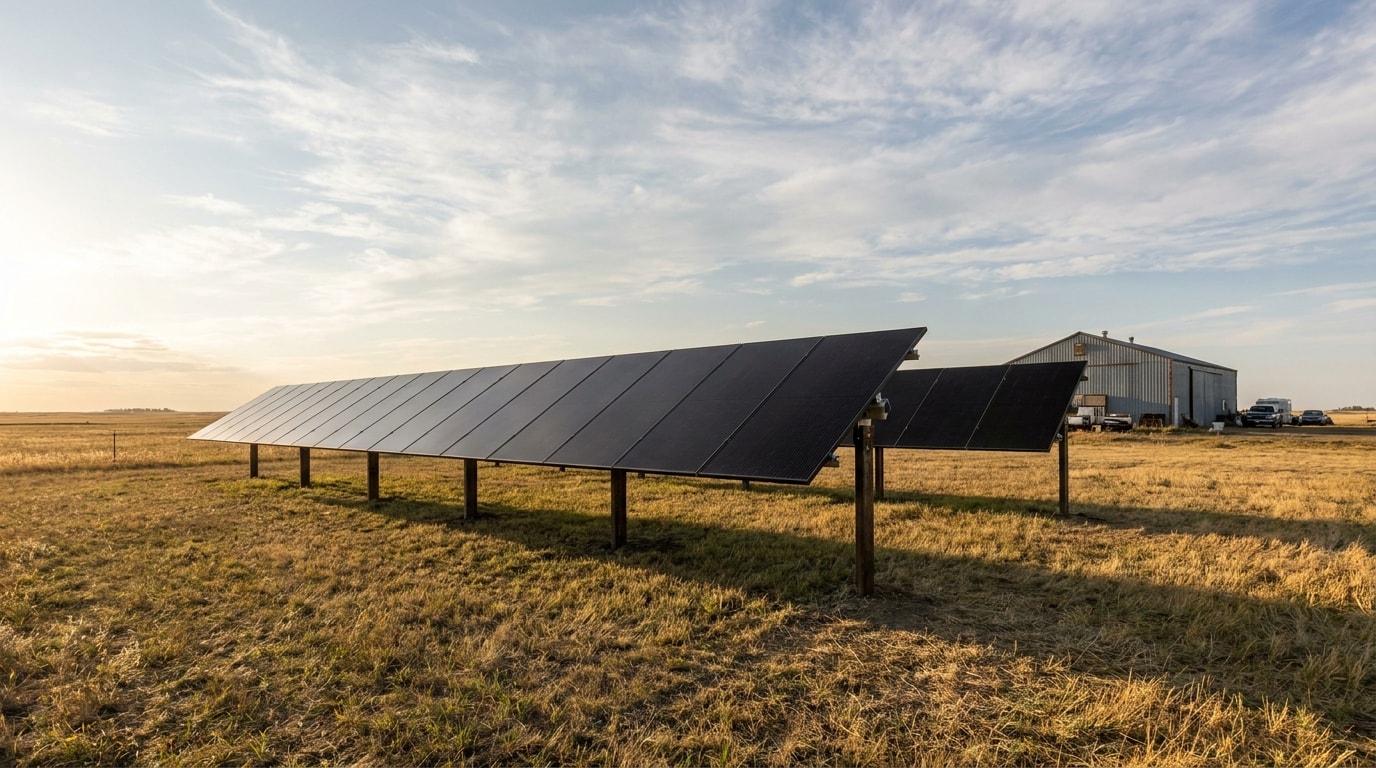
The structure is steel piles driven into the ground, supporting a frame that holds the panels at a fixed tilt, usually 30 degrees in Alberta to balance summer production and winter snow shedding. No concrete pad. No earthworks. The pile rig drives the posts on day one, and the rack and panels go up over the following day or two.
The array sits low, typically 4 to 6 feet off the ground at the highest point. Modern designs are clean: powder-coated steel, all-black panels, no exposed wiring. The inverter cabinet mounts at the array or runs back to the panel box in the house. Trenching from the array to the main service goes about 18 to 24 inches deep, capped with conduit.
From a quarter mile away on an Alberta acreage, a 15 kW ground-mounted array reads as a single dark shape sitting in the grass. Up close it is obviously a solar array, but it is not industrial looking. It does not dominate the property.
The math on a 15 kW acreage ground mount
Here is a worked example for the most common ground-mount case we see: an acreage drawing 16,000 to 18,000 kWh per year between the house, a shop, and a well pump, with a house roof that faces east-west.
A 15 kW ground mount in central or southern Alberta runs approximately $52,000 installed. That figure includes the steel-pile racking, panels, inverter equipment, wiring, and the trench back to your service. Trenching shows up as its own line item on a ground-mount quote, typically $2,000 to $4,000 depending on the run length from the array to the service entrance. A 50-metre run costs a lot less than a 200-metre run, which is why array placement is part of the design conversation rather than an afterthought.
The same 15 kW system on a good roof would run roughly $44,000 to $47,000, so the ground-mount premium works out to about $5,000 to $8,000. What that premium buys is perfect orientation. A south-facing array at the ideal tilt produces 15 to 20 percent more energy per year than the same panels forced onto an east-west roof. On a 15 kW system that difference is roughly 2,500 to 3,500 kWh every year for 25-plus years. Over the life of the system, the production gain recovers the premium several times over.
At current rates, a 15 kW ground mount offsetting that acreage load saves in the range of $3,300 to $3,800 per year, which puts simple payback around 14 to 15 years for a residential purchase. For a farm or incorporated operation, the 30 percent federal Investment Tax Credit applies to the full installed cost, racking and trenching included. On a $52,000 system that is $15,600 back in year one, a net cost of about $36,400, and payback in the 9 to 10 year range. See our Alberta farm solar guide for the full ITC breakdown, and our Alberta solar cost page for pricing across system types.
Snow clearing is a genuine Alberta advantage
One real advantage of ground mount in Alberta winters: you can sweep it. A roof array up high gets whatever the wind and the sun give it. Most days the panels self-shed once production warms them above zero, but heavy wet snow can sit on a roof array for a week.
A ground mount is 4 to 6 feet off the ground. If a January storm dumps 8 inches of wet snow, you can walk out with a soft brush and clear the panels in 20 minutes. That is 20 minutes of work that recovers a full day of production. Roof arrays do not offer that.
FortisAlberta and the microgeneration paperwork
Ground-mounted and roof-mounted solar register under the same Alberta microgeneration framework. Same application, same bi-directional meter swap, same Solar Club credits, same federal Investment Tax Credit. For most rural acreages in central and southern Alberta, the wire service provider handling that application is FortisAlberta. They review the interconnection, and once the install passes electrical inspection they swap your meter for a bi-directional unit and your credits start accumulating. Nothing about mounting on the ground changes the financials beyond the install cost itself. See our Alberta microgeneration guide for the full framework.
Where ground mount does NOT make sense
If you have a perfectly oriented south-facing asphalt-shingle roof with no shading and plenty of space, ground mount is throwing money away. Same if you have a small lot in town with no yard to spare. Roof mount wins in the easy cases. Ground mount is for the cases where the roof is fighting you.
Same goes for acreages where the only open south-facing land is wetland, septic field, or an area you actually need for other things. Do not put panels where you will regret them in five years.
Ground-mount questions we hear on acreages
How much land does a 15 kW ground mount take?
Less than most people expect. A 15 kW array in a two-row layout runs roughly 80 to 90 feet wide and about 15 feet front to back, call it a tenth of an acre once you include working room around it. On a typical 3 to 10 acre parcel, finding that footprint with clear southern exposure is rarely the problem. Keeping it away from future shelterbelts and building plans is the part worth thinking through.
Do the piles need concrete foundations?
Not usually. Driven or screw steel piles are engineered for Alberta frost depths and carry the array without concrete. We check soil conditions during the site assessment. Rocky ground or a high water table can change the foundation approach, and we would rather find that out before the pile rig shows up than after.
Can I mow and graze around the array?
Mowing, yes. The array height leaves room to trim under and around it. Livestock is a different story. Cattle treat a ground mount like a scratching post, so if the array shares a pasture with animals, budget for a simple fence around it. Sheep tend to coexist with arrays just fine, which is why you see them grazing in utility-scale solar fields.
Does a ground mount need different permits?
You still need an electrical permit and the microgeneration application either way. Some counties also want a development permit for a ground-mounted structure, and setback rules from property lines vary by municipality. We handle the permit package as part of the install, so the county paperwork does not land on your desk.
How long from quote to producing power?
Permits and the interconnection review typically take two to four weeks. Install happens two to six weeks after permits clear. The build itself runs one to three days: piles driven, racking assembled, panels mounted, trench cut and closed. After inspection, FortisAlberta swaps the meter and the system starts producing credits.
How we approach a ground mount in Alberta
We install ground-mounted systems across rural Alberta on acreages, farms, and shop properties, anywhere the roof is not the right answer. We use steel-pile racking rated for Alberta winters and we size systems to fully offset annual consumption (see our grid-tied solar primer for why full offset matters).
Site assessments are free. We come out, walk the property, look at where the sun actually falls during the day, check soil conditions for the pile rig, and review your bills. Then we send you a real design with real numbers. Roof mount, ground mount, or both, whichever makes the most sense for your specific property.
Call 587-330-7502 or book a free 15-minute review at rangeroadsolar.com/book. Straight answer. No pressure. Just the number.
Jonathan
Ground mounts make the most sense on open south-facing land: acreages in Rocky View County solar, farms in Mountain View County solar installer, and rural properties across solar in Red Deer County.
Ready to get a real number for your property?
Send us your most recent power bill. We'll review your consumption and give you an honest design and cost estimate. No obligation.