Location Guide · May 12, 2026 · 7 min read
Solar in Wheatland County, Alberta: Farm Country. Big Bills. A Roof That Can Pay You Back.
Solar in Wheatland County: FortisAlberta rules, real installed costs, hail and wind durability, and worked payback math for acreages.
You already know your power bills are too high out here
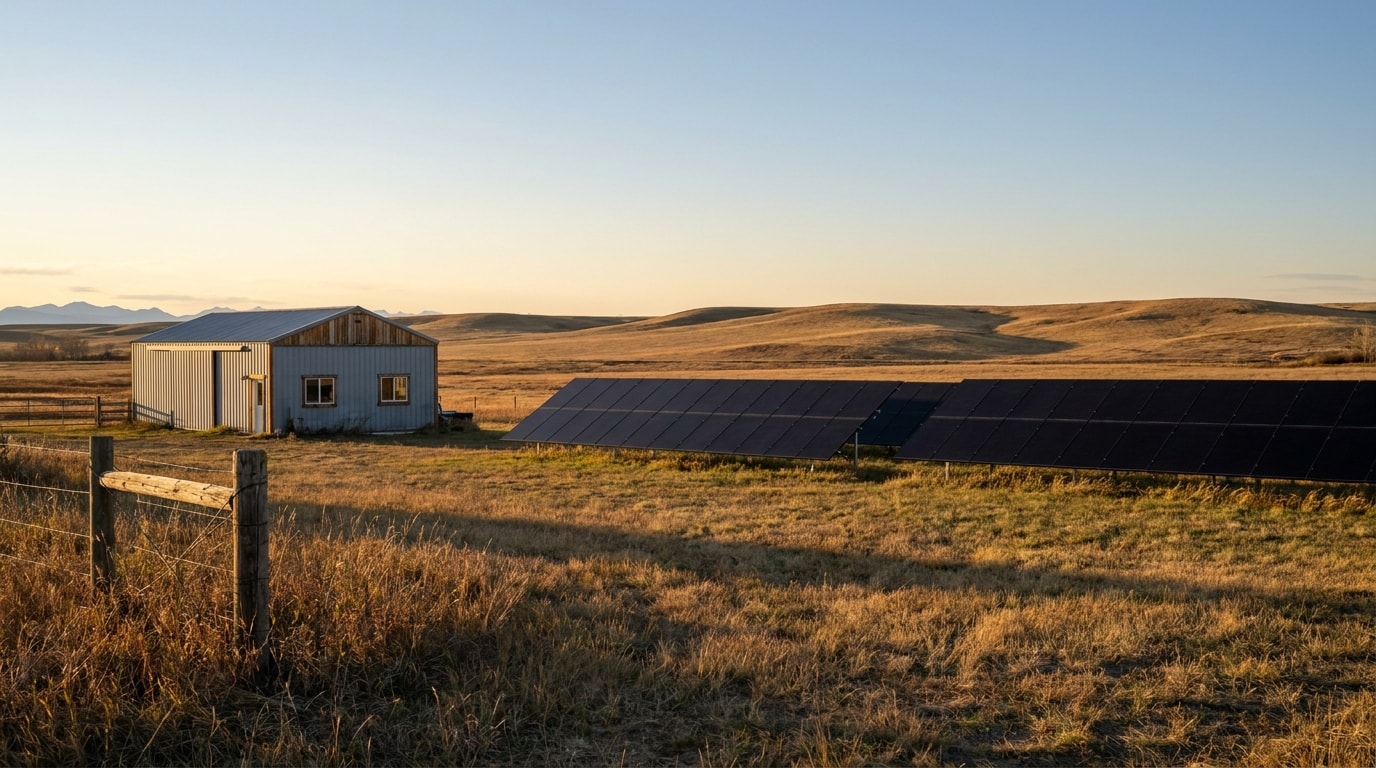
Wheatland County covers a stretch of east-central Alberta that most people blow through on the way to somewhere else. Strathmore to the west, Rockyford to the north, Gleichen to the east, Hussar and Standard in between. Farms, acreages, shops, small commercial buildings. And power bills that have been climbing for years.
A well-sized solar system eliminates the energy portion of your power bill over the course of a year. Not trims it. Eliminates it. That is the realistic outcome on most south-facing roofs in Wheatland County when the system is designed correctly and registered properly under Alberta's microgeneration framework. This post walks through how the utility side works out here, what a system actually costs, and how long it takes to pay for itself.
FortisAlberta territory: how the grid connection works
Wheatland County is FortisAlberta territory. When you go solar, FortisAlberta installs a bi-directional meter and you become a microgeneration customer under Alberta's provincial framework. Everything stays connected to the grid. There is no battery requirement and no separation from the utility.
Surplus power, meaning everything your panels produce beyond what you are using at that moment, flows onto the grid. FortisAlberta credits your bill for it. When you need power the panels are not producing, you draw from the grid and those credits offset the cost. The result is a bill that trends toward zero over the year.
For the full paperwork timeline and a plain-language breakdown of how credits appear on your statement, see our Alberta microgeneration guide.
Solar Club: Alberta's summer production advantage
Alberta's electricity market has a structure that rewards solar owners. Under Solar Club, when your system overproduces from May through September, you receive credit at the current retail market rate. In recent years that has been 30 to 33 cents per kilowatt-hour. A large system on a shop or barn roof can build substantial credits through the peak production months.
Winter rolls in. Production drops. Your grid draw goes up. The summer credits carry you through it. The year ends and your net power cost is close to zero or at zero.
The key is correct sizing. A system designed to offset only 70 or 80 percent of consumption usually does not generate enough summer surplus to carry the winter draw. We size systems to your full annual consumption within FortisAlberta's microgeneration rules because that is what makes the annual math work.
If your operation is incorporated or a farm: the 30% ITC
The federal Investment Tax Credit applies to solar installations on farms and incorporated businesses at 30 percent of the total system cost, credited in year one. On a $35,000 commercial installation, that is $10,500 back against your tax bill.
Wheatland County has no shortage of properties that qualify: grain operations, cattle ranches, mixed farms, incorporated acreages, shops, and commercial buildings along Highway 1 and Highway 21. If your operation files corporate taxes, the ITC is worth running past your accountant before your fiscal year closes. It takes roughly a third off the payback period compared to a straight residential purchase.
Typical Wheatland County solar numbers
| Residential / acreage | 8 – 14 kW | $28,000 – $48,000 installed |
| Farm shop / outbuilding | 15 – 50 kW | $48,000 – $125,000 installed |
| Federal ITC (incorporated) | 30% in year one | Farms and business operations |
| Annual savings (home) | $2,000 – $3,800 | Based on current FortisAlberta rates |
| Annual savings (shop) | $4,500 – $12,000 | Depends on consumption and system size |
| Simple payback | 13 – 15 yrs residential | 9 – 10 yrs with ITC for incorporated ops |
The math on a 10 kW Wheatland County system
Here is a worked example using numbers we actually see in the county. Take an acreage outside Strathmore using around 12,000 kWh per year between the house, a garage, and a well pump. A 10 kW system on a south-facing roof produces roughly 11,000 to 12,000 kWh annually in this part of Alberta, which puts the property at or near full annual offset.
Installed cost for a 10 kW residential system runs $34,000 to $38,000 depending on roof complexity, equipment selection, and whether the electrical service needs any upgrades. At current FortisAlberta rates, with Solar Club credits on the summer overproduction, that system saves roughly $2,400 to $2,800 per year.
Simple payback lands between 13 and 15 years. That is the honest number before any rate escalation. Alberta power rates have not been flat for a decade, and every increase shortens the payback. Factor in even 3 percent annual escalation and the payback tightens by a year or two. The panels carry 25-year production warranties, so the system keeps producing long after it has paid for itself.
If the property is a farm or the operation is incorporated, the 30 percent ITC changes the picture entirely. A $36,000 system nets out to about $25,200 after the credit, and payback drops into the 9 to 10 year range on the same annual savings.
Commercial buildings on Highway 21 and Highway 1
Not every solar conversation in Wheatland County happens on a farm. There are shops, service businesses, and commercial properties along both highways with large south-facing roofs that sit empty and face the Alberta sun all day. For a building running $1,500 to $4,000 per month in power costs, the payback on a commercial system can be aggressive, particularly when combined with the ITC and the summer Solar Club rates.
If your building has a south-facing roof and a meaningful power bill, the assessment is worth doing. The numbers either work or they do not, and we will tell you honestly which one it is.
Common questions from Wheatland County property owners
Does hail damage solar panels out here?
Wheatland County sits close to Alberta's hail corridor, so this is a fair question. Quality panels are rated for one-inch hail at terminal velocity, which covers the large majority of storm events. For the outliers, your home insurance is the backstop. Most acreage policies cover solar panels as part of the structure once the insurer is notified. Some charge a small additional premium. Tell your broker before the install and factor that into your annual numbers.
What happens to production in winter?
It drops. That is latitude, not a defect. A 10 kW system producing 11,500 kWh per year might generate only 400 to 600 kWh in December against 1,500 or more in July. The microgeneration credit system is built for exactly this. You bank credits through the long summer days and spend them through the dark months. You still pay FortisAlberta's fixed distribution and service charges year round. Solar removes the energy charge, not the fixed fees.
Do I need batteries?
No. A grid-tied microgeneration system uses the grid as your storage. Summer surplus becomes bill credits instead of charging a battery in your garage. Batteries make sense if you want backup power through an outage, but they add significant cost and they are not required for the economics to work in Wheatland County.
Can the panels go on my shop instead of the house?
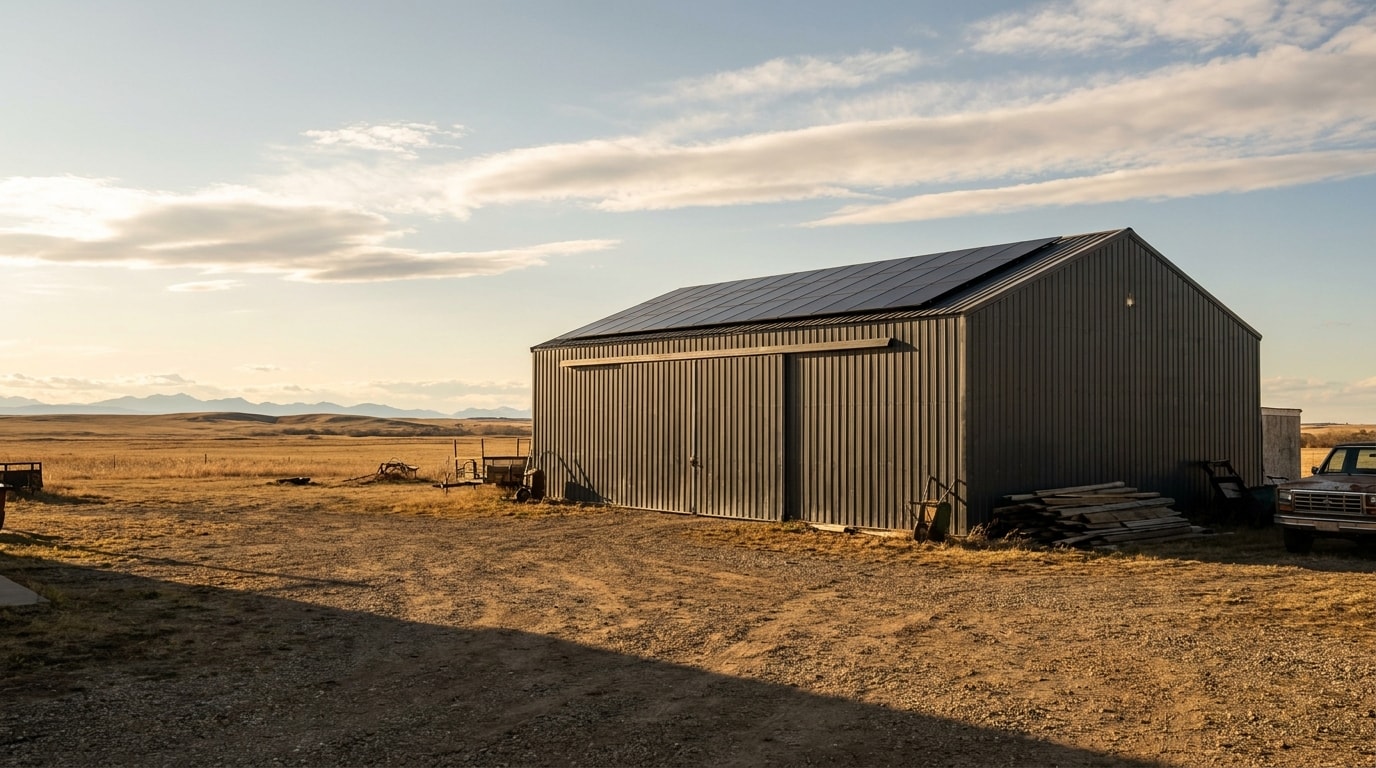
Usually yes, and often the shop is the better roof. Alberta microgeneration ties to a single meter point, so if the house and shop run through one service, we simply put the array on whichever building has the best orientation and structure. If they are on separate meters, each meter needs its own application, and we will tell you during the site visit which layout makes sense.
How long does the whole process take?
Design and quote take about a week once we have your bills. Permits and the FortisAlberta interconnection review typically run two to four weeks. Install happens two to six weeks after permits clear, and most residential and farm systems go up in one to three days on site. After the electrical inspection, FortisAlberta swaps in the bi-directional meter and the system starts earning credits.
We come to you
Site assessments are free. We drive out to your property, look at your roof and service entrance, pull your most recent power bill, and give you a real design with real numbers, not an online estimate built from satellite photos that has never seen your land. If the system makes sense, we show you exactly why. If it does not, we say that instead.
Range Road Solar covers all of Wheatland County including Strathmore, Rockyford, Gleichen, Hussar, Standard, and the surrounding rural areas. Call us at 587-330-7502 or book a free 15-minute review at rangeroadsolar.com/book. Bring your most recent power bill and we will give you a straight answer on whether solar pencils out for your property.
Jonathan
Ready to get a real number for your property?
Send us your most recent power bill. We'll review your consumption and give you an honest design and cost estimate. No obligation.
Range Road Solar covers all of Wheatland County solar, including Strathmore solar installer to the west and solar in Gleichen to the east.
Range Road Solar Team
Rural Alberta Solar Installers
Our team has been installing solar across rural and central Alberta since 2019. Over 218 installs on farms, acreages, shops, and homes. We write about what we have actually seen in the field — not what the brochures say.
Serving Wheatland County & Area