
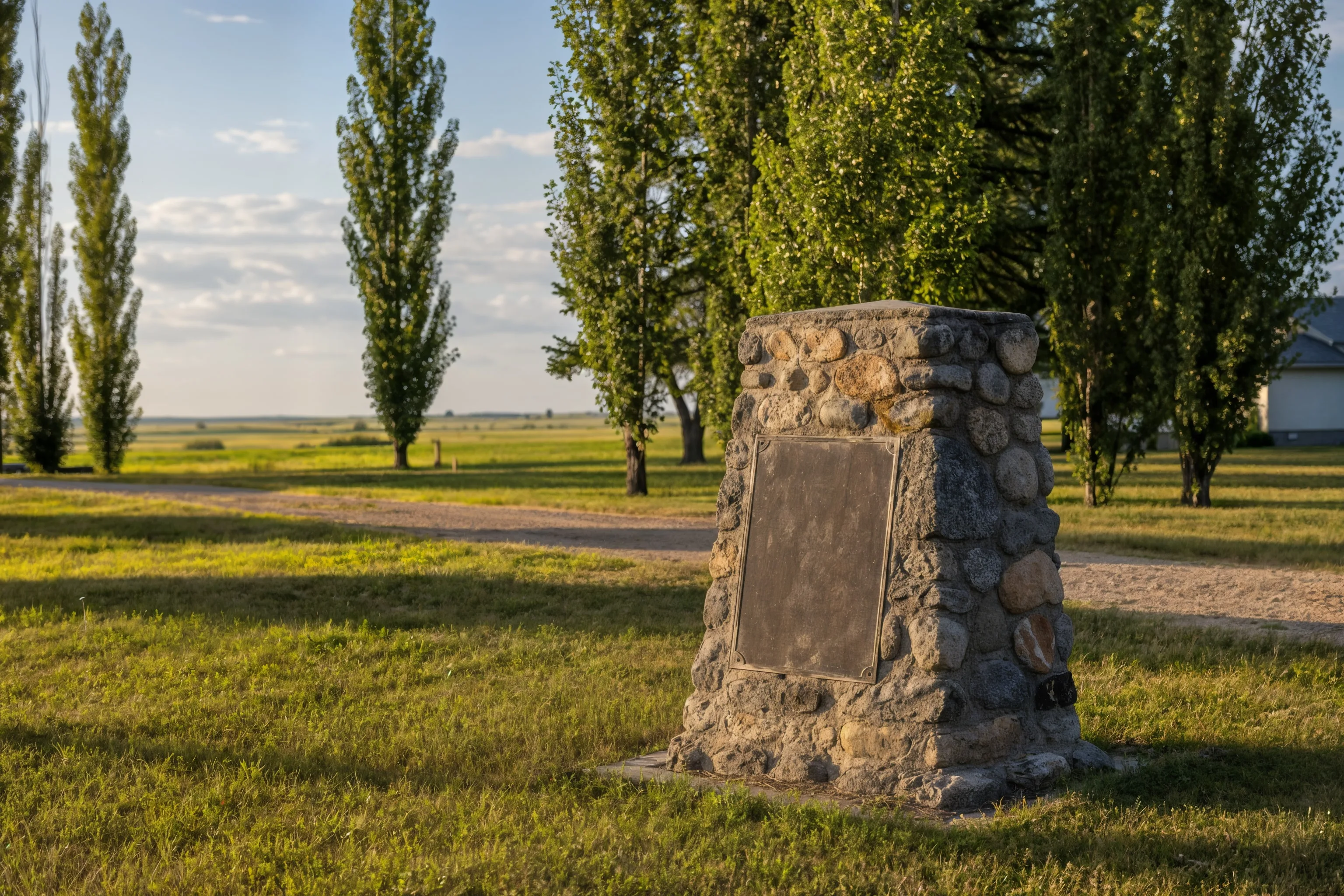
Who Calls Us From Hay Lakes
Hay Lakes inquiries come from village homeowners on standard in-town lots, and from grain and mixed farm operators on the quarter sections that surround the village. Hay Lakes is a small place, 456 people as of the 2021 census, down from 495 in 2016, and the housing stock in the village runs older and established. A retiree with no mortgage looks at solar math very differently than a farm family financing new equipment every few years, and we design proposals around that difference rather than pushing one script at everyone.
The village sits on Highway 21 in Camrose County, about 32 km north of Camrose and roughly 50 km southeast of Edmonton. Most of what we install here is straightforward rooftop residential in the village itself, plus farm-scale ground-mount and shop-roof systems out on the range roads. We do not oversell a market this size. But the physics of solar do not care how many people live in a town, and the math works the same here as it does anywhere else in central Alberta.
Why Solar Works in Hay Lakes
Hay Lakes sits at roughly 53.19 degrees north, 113.06 degrees west. There is no Environment Canada sunshine sensor in the village itself, but the nearest station that records bright sunshine duration, Edmonton International Airport, about 50 km to the northwest, logs an annual average of roughly 2,310 bright sunshine hours under the current climate normal. That is a duration measurement, not the "peak sun hours" figure a solar calculator uses, but it tells you this stretch of the Edmonton-Camrose corridor gets a lot of clear sky, concentrated hard into the April-through-August run when a grid-tied system does most of its annual production. For an actual production estimate, we work from a regional figure in the neighbourhood of 1,150 to 1,250 kWh per kW of installed capacity per year for a south-facing, latitude-tilt array in this part of central Alberta, and we refine that further with satellite-modelled tools once we have seen your specific roof.
On the wire service question, we tell you exactly what we found and did not find. Camrose Energy markets electricity and natural gas retail rates to Hay Lakes customers, but a retailer bills you for energy, it does not own the poles and transformers. We could not locate a Hay Lakes-specific franchise filing naming the distribution utility outright. What we can confirm: the neighbouring Camrose County villages of Bittern Lake and Bawlf are both listed as FortisAlberta territory in Alberta Utilities Commission municipal franchise fee filings, and FortisAlberta serves the large majority of rural Camrose County generally. That makes FortisAlberta the strong working assumption for Hay Lakes properties, and we confirm the actual distributor on file for your specific address before we design or submit any micro-generation application, rather than guess and find out later.
A Village Built Around a Telegraph Line
Hay Lakes was incorporated in 1928, initially as the Village of Hay Lake, taking its current name in 1932. The area was settled largely by Swedish and Norwegian immigrants, and its name comes from the hay marshes that once surrounded it. Founding pioneer James McKernan set up a telegraph station here in 1876, and that history is preserved today at Telegraph Park, an 88-acre municipal park with camping and fishing that sits on the site of the original station. The Hay Lakes Telegraph Station itself is listed on the Alberta Register of Historic Places as a Provincial Historic Resource, marking the spot where the first message went out over that section of line in 1877. The Canadian National Railway's Edmonton-to-Calgary line came through in 1911, and the village still sits along that transportation corridor today.
Grain farming dominates the land around Hay Lakes, consistent with the mixed-farming character of Camrose County generally. The village itself has a K-12 school, a community hall, a recreation centre, a library, and Main Street businesses including a grocery store and gas station. The terrain is flat, open Camrose County farmland with minimal tree cover, which means shading is almost never a design constraint here, whether the array goes on a village rooftop or a pole barn out on a quarter section.
What a System Looks Like on a Hay Lakes Property
Village Home on a Standard Lot
Most Hay Lakes village homes are older bungalows on standard lots, with monthly bills in the $150 to $220 range depending on the season. A 6 to 8 kW rooftop system, installed roughly $13,500 to $22,800 at $2.25 to $2.85 a watt, handles most of a typical household's annual electricity use.
Village Home Plus Detached Garage or Shop
A house plus a heated garage or small trade shop typically pushes monthly bills into the $220 to $320 range. An 8 to 10 kW system, roughly $18,000 to $28,500 installed, split across the house and garage roof where orientation allows, is the usual fit.
Grain Farm on the Range Roads Around Hay Lakes
Grain operations running dryers, augers, yard lights, and shop heat see bills that swing hard by season, often $350 to $600 a month during harvest and deep winter. These properties are frequently better suited to ground-mount arrays when the shop roof is undersized or poorly oriented. A 12 to 16 kW system, roughly $30,000 to $56,000 installed (ground-mount pricing runs $2.50 to $3.50 a watt), is typical, sized to actual annual consumption.
Snow Load and Frost Depth
Hay Lakes sits in the same general snow-load band as the rest of central Camrose County. The nearest municipality with a published National Building Code ground snow load figure is Camrose itself, at 2.0 kPa, and that is the figure this design uses until a Hay Lakes-specific value exists. For ground-mount systems, the Edmonton-region standard calls for a minimum footing depth of 1.2 metres, though local geotechnical practice in this part of the province commonly runs footings to 5 feet or deeper for installations meant to hold steady through decades of freeze-thaw cycling. Every ground-mount post we install is sized to the racking manufacturer's engineering spec for our actual local frost and snow conditions, not a generic number pulled from a warmer part of the province.
Hay Lakes Solar System Sizing and Savings Estimates
Based on $2.25 to $2.85 a watt installed for roof-mount systems, a regional production estimate of roughly 1,150 to 1,250 kWh per kWp per year for this part of central Alberta, and a blended Alberta residential rate of roughly 23 cents/kWh.
| System Size | Annual Production | Year 1 Savings | Simple Payback |
|---|---|---|---|
| 6 kW | ~6,900 to 7,500 kWh | ~$1,587 to $1,725 | ~7.8 to 10.8 yrs |
| 10 kW | ~11,500 to 12,500 kWh | ~$2,645 to $2,875 | ~7.8 to 10.8 yrs |
| 14 kW | ~16,100 to 17,500 kWh | ~$3,703 to $4,025 | ~7.8 to 10.8 yrs |
Payback shortens for incorporated farm or business operations that qualify for the 30 percent federal Investment Tax Credit on capital equipment. There is currently no Alberta residential solar rebate. Ground-mount farm systems run $2.50 to $3.50 a watt, reflected in the load-profile figures above rather than this roof-mount table.
What We Put on Hay Lakes Properties
We put LONGi panels on every Hay Lakes roof. It is the highest-volume solar panel manufacturer in the world, and the panels carry a 25-year product warranty while tolerating temperature extremes from minus 35 to plus 35, which covers everything this part of Camrose County throws at them. Village and acreage rooftops get APsystems microinverters, each pair of panels running on its own circuit, so a shaded or snow-covered section never drags down the rest of the array. When a Hay Lakes farm needs a bigger system, we switch to Solis inverters, sized for higher-capacity installs.
How We Work with Hay Lakes Properties
Power Bill Review
Share your most recent power bill. We analyze your consumption to determine the right system size and calculate projected savings specific to your property.
Site Visit to Hay Lakes
We drive to your property and assess the roof, electrical infrastructure, shading, and ground conditions. No charge, no obligation.
Custom Design
A detailed system design with panel layout, production estimate, cost breakdown, incentive eligibility, and payback timeline specific to your property.
Permitting
We handle building permits, electrical permits, and confirm your actual wire service distributor before submitting the micro-generation interconnection application. You sign once, we follow up on everything.
Installation
Licensed electricians install racking, panels, inverters, and all electrical connections. One to two days for residential, two to three for farm-scale.
Grid Connection
Final inspection, commissioning, and grid connection. Your system starts producing power and you start seeing the savings on your bill.
Hay Lakes Solar, Frequently Asked Questions
218+ installations. Zero shortcuts.
Read what Alberta property owners say about our work.
Free Solar Assessment for Hay Lakes Properties
Village home, acreage, or farm, we will come to you and give you an honest number.
Also Serving Near Hay Lakes
Get a Solar Quote for Your Hay Lakes Property
Tell us your address and a recent power bill, and we will confirm your actual wire service distributor, what system size fits your usage, and what it costs installed. No generic estimate, no inflated range.
Also Serving Nearby Communities