
Who Calls Us From Hussar
Hussar is a small village in Wheatland County, southern Alberta, with a population of 164 at the 2021 census, down from 190 in 2016. It sits on Highway 561, about 93 km east of Calgary and 55 km south of Drumheller. The village was founded around a Canadian Pacific Railway station in 1913 and incorporated in 1928. It is small, and we do not pretend otherwise, but a small population does not change what solar does to a power bill. The math is identical whether you are one of 164 residents or one of a million.
Wheatland County's farms average well over a thousand acres, and the county carries more than 160,000 head of cattle and calves, so calls from the Hussar area split into two groups: village residents on a standard lot trying to flatten a power bill that keeps rising, and grain or cattle operators on the land surrounding the village running bins, block heaters, and grain-handling motors hard through the winter, one of which operates a seed cleaning plant right in Hussar. That second group is exactly the load profile where a properly sized solar system earns its keep fastest.
Why Solar Works in Hussar
Hussar sits at roughly 51.04 degrees north, 112.68 degrees west, on flat, open prairie with essentially no tree cover or terrain to cast shade. There is no Environment Canada sunshine-recording station in the village itself. The nearest long-run station with a published bright sunshine normal is Calgary International Airport, about 90 km west, which logs 2,396 hours of bright sunshine a year under the 1981 to 2010 climate normals, among the highest totals recorded at any major Canadian airport. Bright sunshine hours are a duration measurement, not the "peak sun hours" figure used in solar production calculators, but the number tells you plainly that this stretch of southern Alberta sees a lot of clear sky, loaded heavily into the April-through-September months.
Natural Resources Canada's photovoltaic potential mapping puts Calgary at approximately 1,290 kWh of production per kW of installed capacity per year for a south-facing, latitude-tilt array. We have not located an NRCan estimate published for Hussar by name, so we treat the Calgary figure as a same-region reference point rather than a site-specific one, and we run actual production modelling for your exact property and roof or ground orientation before quoting a number. FortisAlberta owns the distribution wires serving Hussar and the rest of Wheatland County, the same utility that serves Strathmore, Gleichen, and Three Hills. Every grid-tied system goes through FortisAlberta's micro-generation application: they review the design, verify the panel and conductor sizing can handle the backfeed, and install a bi-directional meter, typically a four-to-eight-week process. We handle that application as part of every install.
A Rail Village on the Wheatland County Plains
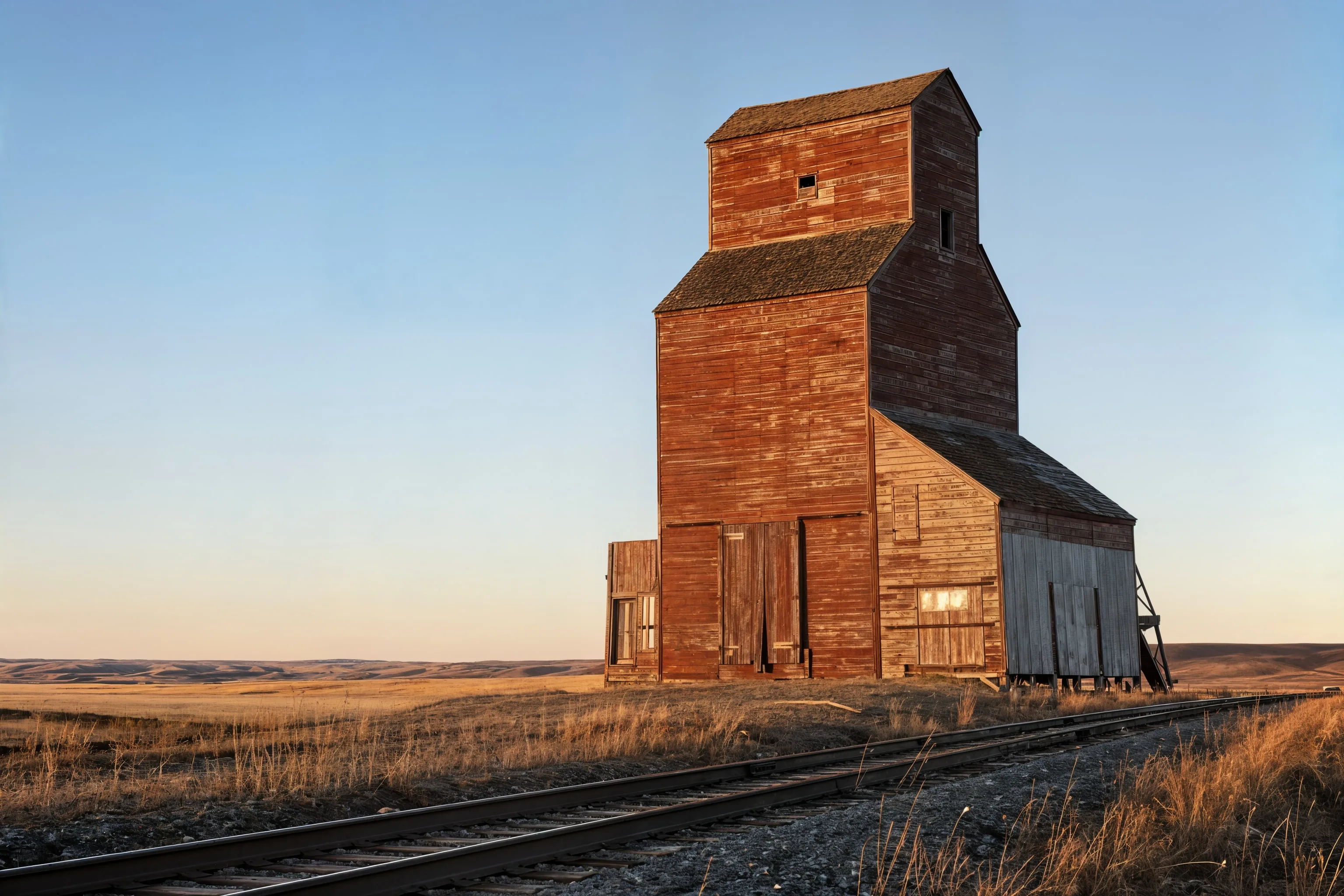
Hussar traces back to a Canadian Pacific Railway station established in 1913, taking its name from a Hussar cavalry regiment that had farmed in the area before the First World War. The village incorporated in 1928. Its most visible remaining landmark is the wooden grain elevator on the old rail line, an ex-United Grain Growers elevator built in the early 1980s, one of the last wooden grain elevators built anywhere in Canada. Photographs confirm it was still standing as of 2020. At one point in the 1990s, Hussar had a row of six grain elevators; the CP rail spur that served them is no longer active, but the one remaining elevator is a real, documented structure on the townsite, not a generic prairie stock photo.
The land around Hussar is flat, open Wheatland County farm and ranch country, with grain, cattle, and a local seed cleaning plant forming the backbone of the area economy. The same open plains that suit grain farming leave a clear, unobstructed sky over most rooftops and yards, so shading is rarely a design concern out here.
What a System Looks Like on a Hussar Property
Village Home on a Standard Lot
Most Hussar village homes carry monthly bills in the $150 to $230 range depending on the season. A 6 to 9 kW rooftop system, installed roughly $13,500 to $25,650 at $2.25 to $2.85 a watt depending on the roof and equipment, offsets most of a typical household's annual electricity use.
Home Plus Shop or Grain-Handling Equipment
A house plus a shop or seasonal grain-drying and handling equipment usually pushes bills into the $230 to $380 monthly range, with sharp seasonal spikes at harvest. A 9 to 12 kW system, roughly $20,250 to $34,200 installed on a roof-mount basis, is a typical fit, sized to the actual seasonal usage pattern rather than an average.
Acreage or Cattle Operation
Rural Wheatland County properties running well pumps, block heaters, and heated waterers for cattle see bills that swing seasonally, often $350 to $550 a month in winter. A 12 to 15 kW system, roughly $30,000 to $52,500 installed (ground-mount pricing runs $2.50 to $3.50 a watt), is typical here, sized to actual annual consumption and often built as a ground-mount array where roof space or orientation does not cooperate.
Snow Load and Frost Depth
Hussar has no NBC ground snow load figure of its own. Strathmore, the nearest Wheatland County municipality with a published value, sits at approximately 0.9 kPa, and that is the figure we build to here until a site-specific number exists. Frost depth for this part of the county runs roughly 1.8 metres; ground-mount posts go to 2.0 metres or deeper regardless, well past that line. Open prairie around Hussar holds sustained cold without much chinook relief, so foundation depth is not something we shortcut, no matter how far the property sits from Strathmore's weather station.
Hussar Solar System Sizing and Savings Estimates
Based on $2.25 to $2.85 a watt installed for roof-mount systems, a same-region production estimate of roughly 1,250 to 1,290 kWh per kWp per year (Calgary's NRCan figure, used as the nearest reference point), and a blended Alberta residential rate of roughly 23 cents/kWh.
| System Size | Annual Production | Year 1 Savings | Simple Payback |
|---|---|---|---|
| 6 kW | ~7,620 kWh | ~$1,753 | ~7.7 to 9.8 yrs |
| 9 kW | ~11,430 kWh | ~$2,629 | ~7.7 to 9.8 yrs |
| 12 kW | ~15,240 kWh | ~$3,505 | ~7.7 to 9.8 yrs |
Payback shortens for incorporated farm or business operations that qualify for the 30 percent federal Investment Tax Credit on capital equipment. There is currently no Alberta residential solar rebate.
What We Put on Hussar Properties
Every install starts with LONGi panels, the world's highest-volume solar panel manufacturer, chosen because the hardware holds up: a 25-year product warranty and a rated operating range from minus 40 to plus 35 that covers anything a Wheatland County winter produces. Homes get APsystems microinverters wired in independent pairs, so dust or snow settling on one panel does not touch the output of the rest of the array. Larger grain and cattle operations around Hussar move up to Solis inverters, built for higher-capacity farm systems.
How We Work with Hussar Properties
Power Bill Review
Share your most recent power bill. We analyze your consumption to determine the right system size and calculate projected savings specific to your property.
Site Visit to Hussar
We drive to your property and assess the roof, electrical infrastructure, shading, and ground conditions. No charge, no obligation.
Custom Design
A detailed system design with panel layout, production estimate, cost breakdown, incentive eligibility, and payback timeline specific to your property.
Permitting
We handle building permits, electrical permits, and the FortisAlberta micro-generation interconnection application. You sign once, we follow up on everything.
Installation
Licensed electricians install racking, panels, inverters, and all electrical connections. One to two days for residential, two to four for farm-scale.
Grid Connection
Final inspection, commissioning, and grid connection. Your system starts producing power and you start seeing the savings on your bill.
Hussar Solar, Frequently Asked Questions
218+ installations. Zero shortcuts.
Read what Alberta property owners say about our work.
Free Solar Assessment for Hussar Properties
Village home, acreage, or farm, we will come to you and give you an honest number.
Also Serving Near Hussar
Get a Solar Quote for Your Hussar Property
Tell us your address and a recent power bill, and we will tell you what system size actually fits your usage and what it costs installed. No generic estimate, no inflated range.
Also Serving Nearby Communities