
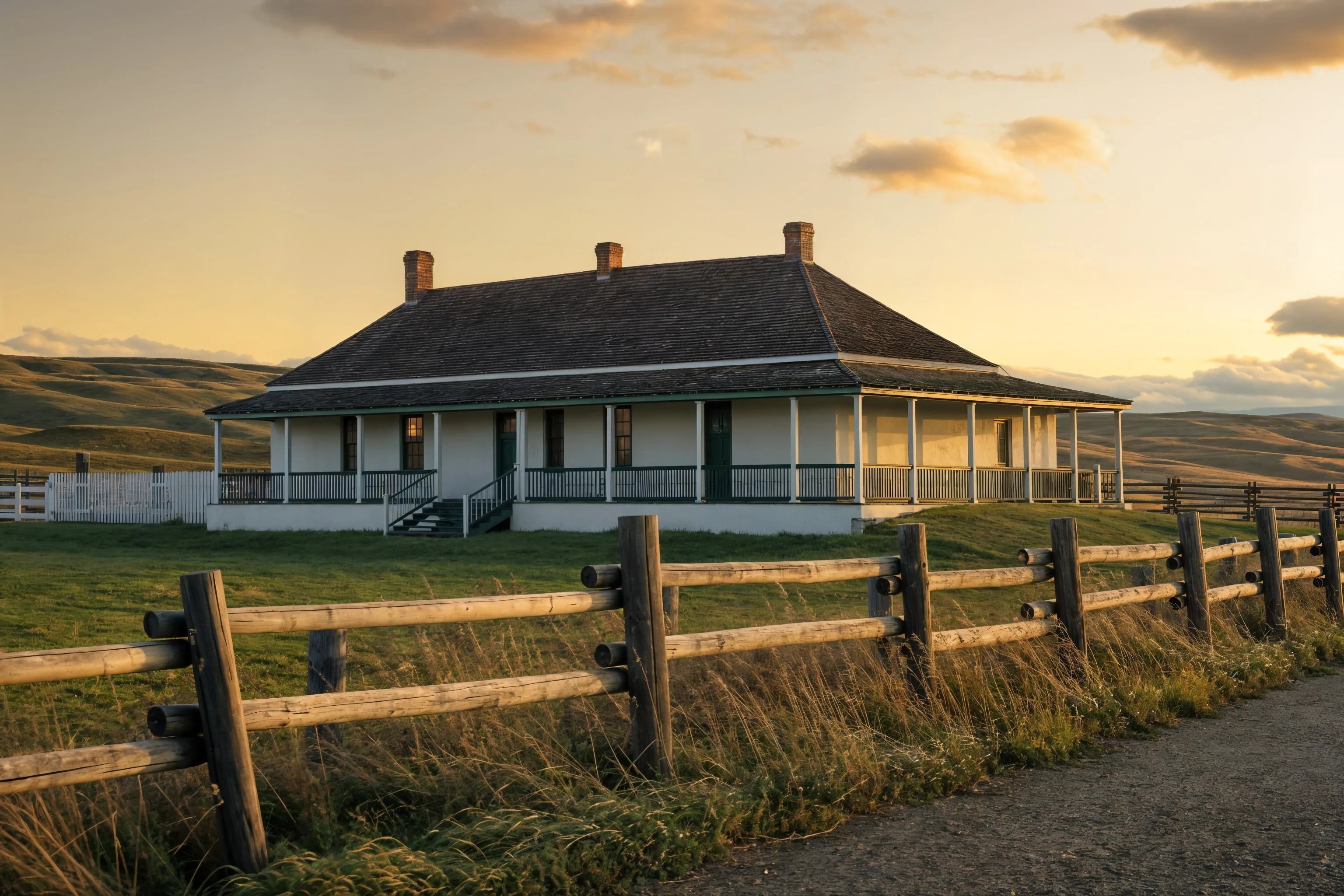
A Fur-Trade Town With a Modern Power Bill
Rocky Mountain House sits on the North Saskatchewan River in the foothills corridor of Clearwater County, at 52.371 degrees north. The name comes from a string of fur-trade posts built along the river between 1799 and 1875 by the North West Company and the Hudson's Bay Company, and the remains of those posts are preserved today at the Rocky Mountain House National Historic Site, a Parks Canada property that still draws visitors and school trips from across the province. The town itself was proclaimed on August 31, 1939, and today counts 6,765 people in the 2021 Census.
The modern economy runs on forestry, oil and gas services, and agriculture. West Fraser Mills operates a sawmill here that is one of the area's major employers, and that industrial base means a lot of local power bills, both residential and commercial, run higher than a pure bedroom community. The nearest Environment Canada station with full climate normals is Red Deer A, which puts the area at approximately 2,208 hours of bright sunshine a year, a solid number for a foothills-adjacent town.
We do not have an NRCan-certified production figure specific to Rocky Mountain House, so instead of guessing we anchor our estimates to a verified local reference: a 7.6 kilowatt system here produces approximately 9,630 kilowatt-hours a year. That scales fairly cleanly with system size, and we walk through exactly what that means for your property before you sign anything.
FortisAlberta Handles Your Wires, ATCO Handles Your Gas
It is worth being precise about this because homeowners sometimes mix the two up. FortisAlberta is the distribution operator that owns and maintains the electrical wires serving Rocky Mountain House and the surrounding Clearwater County properties. ATCO also has a presence in town, but strictly on the natural gas side, a completely separate utility for a separate fuel. ATCO does not touch your electrical service, and it has no role in a solar interconnection. Every micro-generation application for a grid-tied solar system here is filed with FortisAlberta.
Under Alberta's Micro-Generation Regulation, systems up to 150 kilowatts qualify to connect to the grid and earn credit for surplus power exported back through the meter. Your bill breaks down into distribution charges, transmission charges, and an energy charge from whichever retailer you have chosen, and solar offsets the energy portion first, since that is the electricity you would otherwise have to buy.
We prepare and submit the FortisAlberta micro-generation application as part of every install, along with the electrical permits and inspection paperwork. Approval typically takes two to six weeks. You sign a couple of forms, and we handle the back-and-forth with the utility from there.
Three Load Profiles We See Around Rocky Mountain House
Forestry and oilfield service schedules push a lot of Rocky Mountain House power use into odd hours and heavier baseline loads than you would see in a straight commuter town. The ranges below are honest estimates drawn from bills we see across west-central Alberta. Your own 12-month usage history is what actually sizes your system.
The in-town home. A bungalow or two-storey near the historic downtown core or the newer subdivisions, standard heat, one fridge, maybe a freezer in the garage. Bills typically run $170 to $330 a month. A 6 to 8 kilowatt roof system covers a good share of that load across the year.
The acreage with a heated shop. Clearwater County acreages often carry a heated shop for equipment storage or a small side business tied to forestry or oilfield work, plus a pressure system for the house. Bills of $400 to $650 a month are common, and a 10 to 14 kilowatt system, roof or ground, makes a real difference there.
The farmstead or sawmill-adjacent property. Grain handling, yard lighting, and equipment tied to the forestry sector add up. Bills from $550 to $950 a month during a busy season are not unusual. Systems from 15 kilowatts and up, often ground mounts on open acreage, are where the payback math works hardest here.
Heavier Foothills Snow Means Heavier-Rated Racking
Rocky Mountain House sits closer to the mountains than most of the towns we serve, and that proximity means a genuinely heavier winter snow load than you would see out on the open prairie. We do not reuse a southern Alberta racking spec here. Roof mounts are engineered to the local load and tied into the trusses with flashed attachments, and we check the roof structure before quoting, because an older farmhouse roof and a newer shop roof carry weight very differently.
Frost runs deep in this part of Alberta. Ground-mount piles and conduit are set below roughly 1.2 metres, about four feet, so freeze-thaw cycles do not work anything loose over the years. A steeper tilt on both roof and ground mounts helps panels shed snow on their own once the sun is back out, which matters more here given how close we are to the foothills snowbelt.
We have completed 218 or more installs across Alberta, plenty of them in similar snow country, and we spec accordingly: LONGi panels, hail-rated to withstand 35mm stones at 97 km/h with a 25-year product warranty, paired with APsystems microinverters for homes and acreages or Solis inverters for larger farm and shop strings, all on racking rated for the load an engineer stamps for your property.
What Solar Costs in Rocky Mountain House
Roof-mounted solar runs $2.25 to $2.85 per watt installed. A 6 to 8 kilowatt town home system runs roughly $13,500 to $22,800 installed depending on the roof and equipment. Ground mounts run $2.50 to $3.50 per watt to account for trenching, piles, and the heavier racking this snow zone calls for, and they are often the right call on acreages with open south-facing yard.
| Property profile | System size | Installed cost range | Est. first-year production |
|---|---|---|---|
| In-town bungalow or family home | 6-8 kW roof | $13,500 to $22,800 | About 7,600 to 10,100 kWh |
| Larger home or acreage home | 10-12 kW roof | $22,500 to $34,200 | About 12,600 to 15,200 kWh |
| Acreage or farmstead with shop | 12-16 kW ground | $30,000 to $56,000 | About 15,200 to 20,300 kWh |
Production estimates above are scaled from a verified local reference point, a 7.6 kilowatt system producing approximately 9,630 kilowatt-hours a year, rather than an NRCan per-kilowatt figure, since none is certified specifically for Rocky Mountain House. FortisAlberta interconnection and permitting are included in the installed price, and travel from Airdrie is grouped into scheduled trip windows rather than billed as a solo run.
Payback depends on your usage and your retailer's rate, but for the load profiles above, a typical honest range is roughly 9 to 13 years, against 25 to 30 years of panel life. Properties with heavier baseline loads, common here given the forestry and oilfield service economy, tend to pay back faster because every kilowatt-hour generated is one that would otherwise be bought at full retail.
The Process, From a Bill to a Spinning Meter
Send Your FortisAlberta Bill
We start with the 12-month usage graph on your bill. It tells us your real consumption, your highs and lows, and the system size that actually fits your property.
Site Assessment in Rocky Mountain House
We walk the roof or the yard, check shading and panel space, review your electrical service, and talk through roof-mount versus ground-mount options on site.
Design, Quote, and Interconnection
You get an itemized quote with an honest production estimate. We file the FortisAlberta micro-generation application and the electrical permits on your behalf.
Install and Commission
Our crew installs racking rated for this snow zone, panels, inverter, and tie-in over one to three days. Inspection and meter swap follow, then the meter runs backward.
The Drive Reality: Airdrie to Rocky Mountain House
Our shop is in Airdrie, just north of Calgary. Rocky Mountain House is roughly 180 kilometres away, about 155 minutes on the road down Highway 11. That is a genuine trip to send a truck for a single service call, so we do not schedule it that way.
Site assessments and installs around Rocky Mountain House are grouped into scheduled trip windows. Several properties get visited on the same run, materials are staged ahead of the trip, and your install day is booked around that plan rather than a one-off dispatch. From deposit to commissioning, the full process typically runs several weeks, and most of that time is permitting and the FortisAlberta interconnection queue, not labour on your roof or in your yard.
Whether you are in town near the historic site, out on a Clearwater County acreage, or on a farmstead tied to the sawmill or oilfield economy, we cover the whole area the same way: one visit, one plan, one crew that knows foothills snow loads and FortisAlberta paperwork.
Frequently Asked Questions
Get a Solar Design for Your Rocky Mountain House Property
Send a recent FortisAlberta bill and we will come back with an honest assessment: system size, cost range, and what solar can realistically do for your property. No pressure, no brochure numbers.
More Solar Services in Rocky Mountain House
Also Serving Nearby Communities